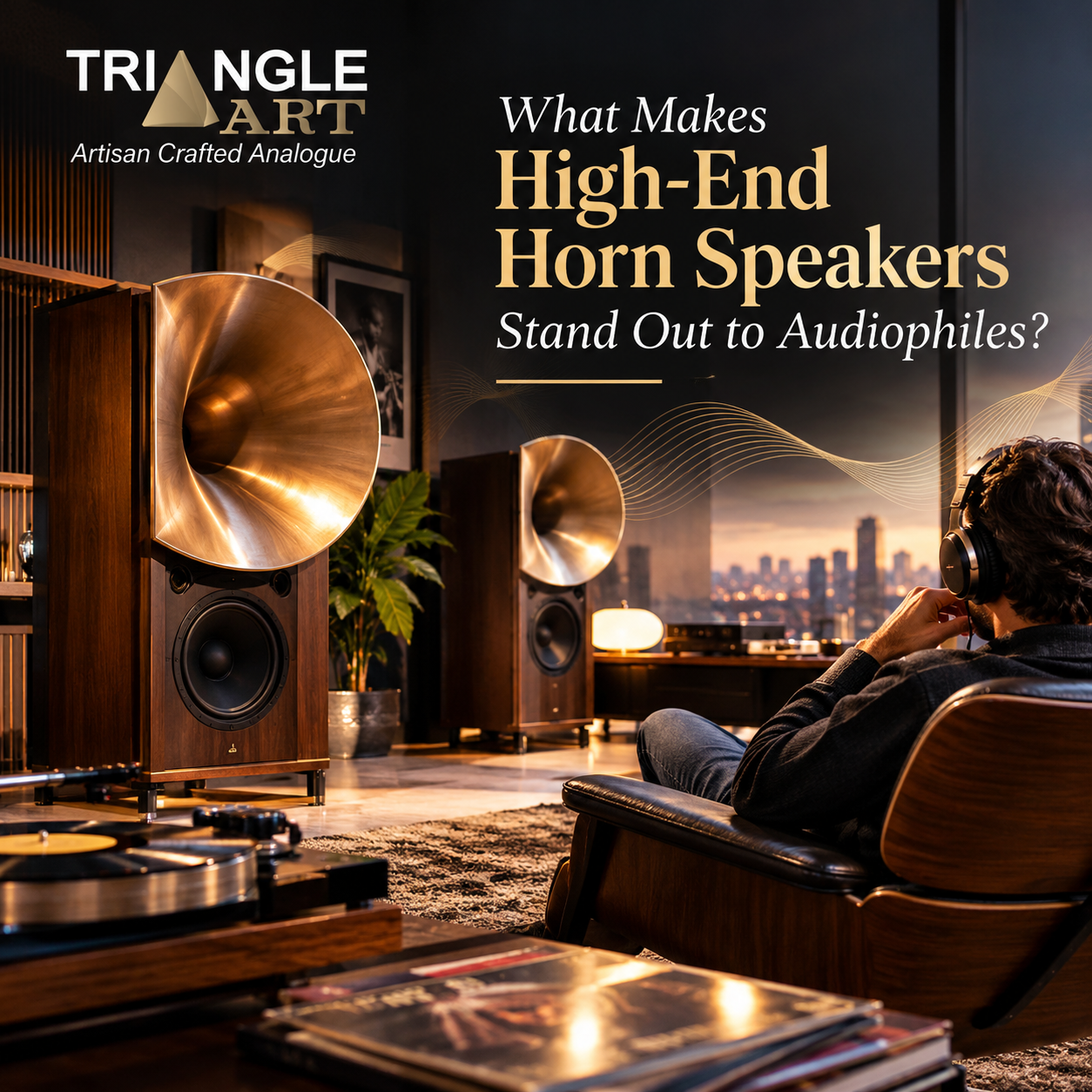
Summary: This blog explains how high-end horn speakers deliver efficient sound reproduction, dynamic performance, and controlled sound dispersion. It covers horn technology, driver configurations, room suitability, and amplifier compatibility while comparing Triangle Art’s Selene and Metis loudspeakers to help audiophiles understand their design differences and choose a suitable audio system.
For music enthusiasts, choosing a high-end loudspeaker involves more than volume or appearance. Many audiophiles explore horn speakers audiophile designs for their potential to deliver high efficiency, dynamic sound reproduction, and controlled sound dispersion. These characteristics make horn-loaded loudspeakers an appealing option for listeners who value musical detail, powerful dynamics, and carefully engineered audio systems.
However, overall performance depends on several factors, including horn geometry, driver quality, crossover design, and room acoustics. Understanding how these elements work together helps listeners evaluate different designs and choose a loudspeaker system that suits their space, equipment, and listening preferences.
Understanding How Horn Speakers Work
Horn speakers use a flared acoustic structure to transfer sound from a driver into the surrounding air. This structure helps couple the driver’s output to the air, allowing many horn-loaded designs to produce higher sound levels with less amplifier power than some conventional speakers.
The horn’s shape and dimensions influence how sound spreads through a room. Different designs produce different dispersion patterns and frequency responses, so horn speakers should not be treated as one uniform category.
This approach appeals to listeners who value efficient amplification, clear musical presentation, and strong dynamic contrast. When properly designed, a horn-loaded loudspeaker can reproduce changes in musical intensity with impressive impact. However, horn loading alone does not guarantee superior sound.
Why Audiophiles Appreciate Horn-Loaded Designs
Music contains a wide range of dynamics, from delicate instrumental passages to powerful orchestral crescendos. A loudspeaker must handle these changes while maintaining tonal balance and presenting individual musical elements clearly.
Horn-loaded designs offer several characteristics that appeal to experienced listeners:
These characteristics make horn speakers attractive to listeners building carefully matched audio systems. Still, cabinet resonance, crossover integration, distortion, and room acoustics remain important considerations.
The Importance of the Horn Driver
A horn works alongside a driver, which generates the sound. The relationship between these components plays a major role in the loudspeaker’s performance. When evaluating a horn driver speaker, audiophiles should look beyond the driver’s physical size or power rating. Sensitivity, frequency response, distortion, dispersion, and crossover integration all affect the final listening experience.
The crossover directs different frequency ranges to the appropriate drivers. If these sections are not integrated properly, the speaker may exhibit uneven tonal balance or noticeable changes around crossover frequencies.
Cabinet construction matters as well because unwanted vibration can affect sound reproduction. Designers must consider how the horn, driver, cabinet, and crossover work together rather than optimizing each component in isolation.
Talk to the Triangle Art team about horn speakers, amplifier matching, and your listening room.
Two-Way and Three-Way Horn Speaker Configurations
Horn-loaded loudspeakers use different driver configurations to reproduce low, midrange, and high frequencies. When comparing a horn driver speaker, understanding the differences between two-way and three-way designs can help audiophiles evaluate their engineering and suitability for different listening environments.
| Feature | Selene: Two-Way Speaker | Metis: Three-Way Speaker |
|---|---|---|
| Configuration | Two driver sections | Three driver sections |
| Woofer | 12-inch woofer | 15-inch woofer |
| Horn design | Horn-loaded 2-inch compression driver | Horn-loaded midrange driver |
| High-frequency driver | Horn-loaded compression driver | RAAL true ribbon tweeter |
| Design approach | Two driver sections cover the intended frequency range | Three driver sections distribute low, midrange, and high frequencies |
| Intended room size | Small and medium-sized listening rooms | Larger cabinet for different listening and system requirements |
When comparing these configurations, consider your room size, amplifier compatibility, and listening preferences rather than focusing only on the number of drivers.
Choosing Small Horn Speakers for Your Room
Room size can influence loudspeaker selection, but physical dimensions alone do not determine whether a speaker will perform well in a particular space. Placement, listening distance, bass response, and room acoustics all affect the result.
When comparing small horn speakers, buyers should consider the full dimensions of the cabinet, including height and depth. They should also check the recommended distance from walls and the listening position.
Before choosing a model, consider these factors:
Triangle Art Selene is designed for smaller and medium-sized rooms, while the larger Metis may suit different space and system requirements. Comparing their dimensions and specifications can help buyers narrow their options.
Matching Horn Speakers With the Right Amplifier
Amplifier selection is another important part of building a high-end audio system. Because many horn-loaded speakers are efficient, they may achieve a desired listening level with less amplifier power than some less-efficient alternatives.
However, efficiency should not be the only consideration. Impedance, amplifier noise, available power, and listening preferences also affect compatibility. A low-powered amplifier may work well with one speaker but struggle with another, particularly at high listening levels or during demanding musical passages.
Buyers should review manufacturer specifications and consider auditioning potential combinations. Listening tests can reveal differences in tonal balance, background noise, and overall presentation that specifications alone may not explain. The objective is to match the amplifier and loudspeakers so that both operate comfortably within their intended ranges.
Conclusion
Horn-loaded loudspeakers offer an approach to audio reproduction that emphasizes efficiency, dynamic capability, and control over sound dispersion. Their performance depends on careful engineering, including driver selection, horn geometry, crossover integration, and cabinet construction.
For audiophiles, the best choice comes from matching these design characteristics with room conditions, amplification, and listening preferences. By evaluating the complete system rather than focusing on one feature, buyers can make informed decisions when exploring high-end loudspeakers.
Have questions about Selene, Metis, or matching them with your amplifier? Get in touch with the Triangle Art team.
(714) 553-6474
info@triangleart.net
Anaheim, CA 92808, USA